Scholarly sources
- FREUDENBURG, WILLIAM R., et al. “MENTAL HEALTH CONSEQUENCES OF RAPID COMMUNITY GROWTH: A REPORT FROM THE LONGITUDINAL STUDY OF BOOMTOWN MENTAL HEALTH IMPACTS.” Journal of Health and Human Resources Administration, vol. 4, no. 3, 1982, pp. 334–352.
- This article talks about the consequences on mental health in communities with rapid growth
- Through this source, I learned that rapid community growth can lead to a significant increase in social problems. In fact, communities who experience rapid growth “appear to have a more serious problem of substance abuse associated with economic change indicators than do communities suffering economic decline.” This source explains that communities who experience growth leads to a condition of “crisis”, sometimes this crisis can be worse than communities experiencing an economic decline.
- McNicoll, Geoffrey. “Consequences of Rapid Population Growth: An Overview and Assessment.” Population and Development Review, vol. 10, no. 2, 1984, pp. 177–240.
- This article talks about the economical and societal consequences of rapid population growth
- This source helped me understand the economical and societal effects of rapid population growth. It explains how multiple different factors have an effect on the economy and social organization, at various levels of the social system and in different institutional settings. In addition, it examines the resulting impact on individual economic and demographic behaviour. I learned that the economic effects of rapid population growth are complicated because it can directly modify institutional configurations as well as have an indirect outcome on individual circumstances.
Non-scholarly sources
- (2020, February 27). Urbanization Causes and Impacts. National Geographic. Retrieved from https://www.nationalgeographic.com/environment/habitats/urban-threats/
- This articles discusses how urbanization spurs a unique set of issues to both humans and animals.
- This article listed a great number of threats (and solutions to these threats) that comes to urbanization and rapid community growth. In fact, this article mentions that an intensive urban growth can lead to greater poverty, with local government unable to provide services for all people. It also mentions that concentrated energy use leads to greater air pollution with significant impact on human health. One last thing this article taught me was that urban development can magnify the risk of environmental hazards such as flash flooding.
- (2018, April 26). Rapid Urbanization and Vertical Sprawl: How can we live like this? WSP. Retrieved from: https://www.wsp.com/en-NL/insights/rapid-urbanization-and-vertical-sprawl-how-can-we-live-like-this
- This articles talks about if and how we are able to live in society with hyper density.
- With the help of this article, I learned that developers and architects have seized the opportunity to raise development values. This article also argues that density (in cities) is a good thing because it is regarded as more sustainable environmentally, socially and economically. Greater density puts more people in practical reach of the services that businesses provide, meaning that the economy will increase. Furthermore, it is estimated that a minimum density of around 30-50 homes per hectare reduces dependency on cars by making the provision of public transport viable and effective, while the placing of shops, services and workplaces within walking reach can get people out of motorized transport altogether.
Cultural or artistic artifact

I chose the story of Oliver Twist as my artistic artifact because it is a good example of what life can be like in rapid population growth communities. In fact, Charles Dickens was an author who lived through the beginning of the Industrial Revolution and wrote stories about what life was like at this time. Oliver Twist is notable for its portrayal of criminals and their lives, as well as for exposing the cruel treatment of the many orphans in London in the mid-19th century. The story showcases how bad life could get during this era.
Example of experimental research
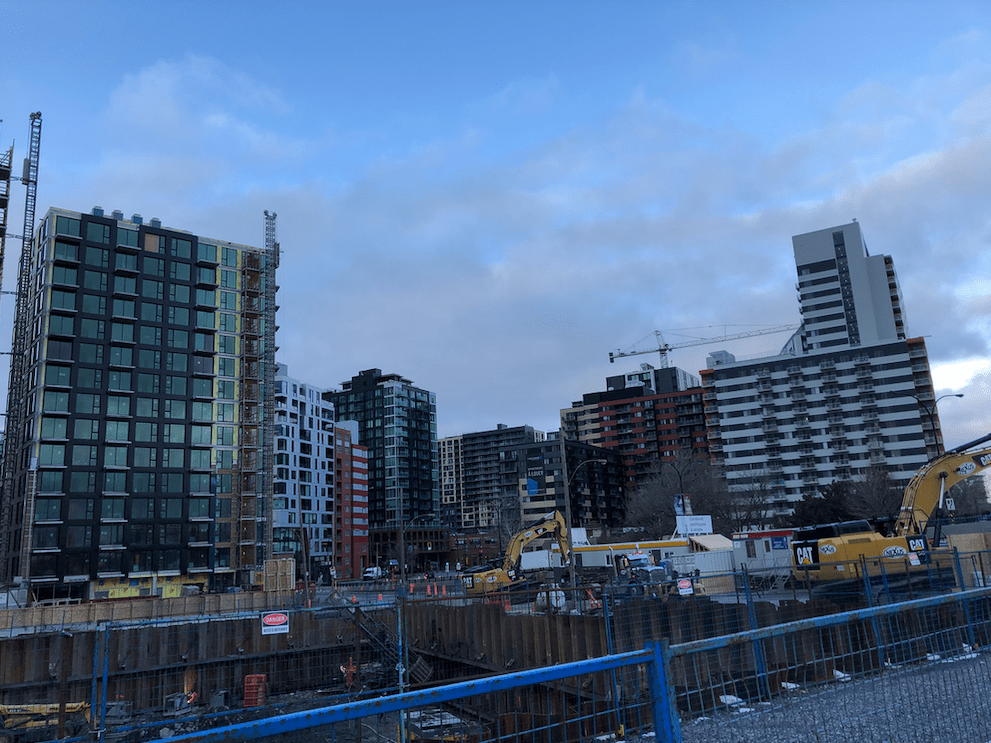
I chose this picture because it shows how much construction there is to put up all these new condo buildings in Griffintown. This shows me the contractors who are in charge with building all of these condo towers care more about function than form. They rather have multiple buildings that do not look nice but make them money than have a neighbourhood that is nice to look at gives more of a sense of community.
 Luke's Blog